XREAL Aura on the shop floor: a screen, not a controller
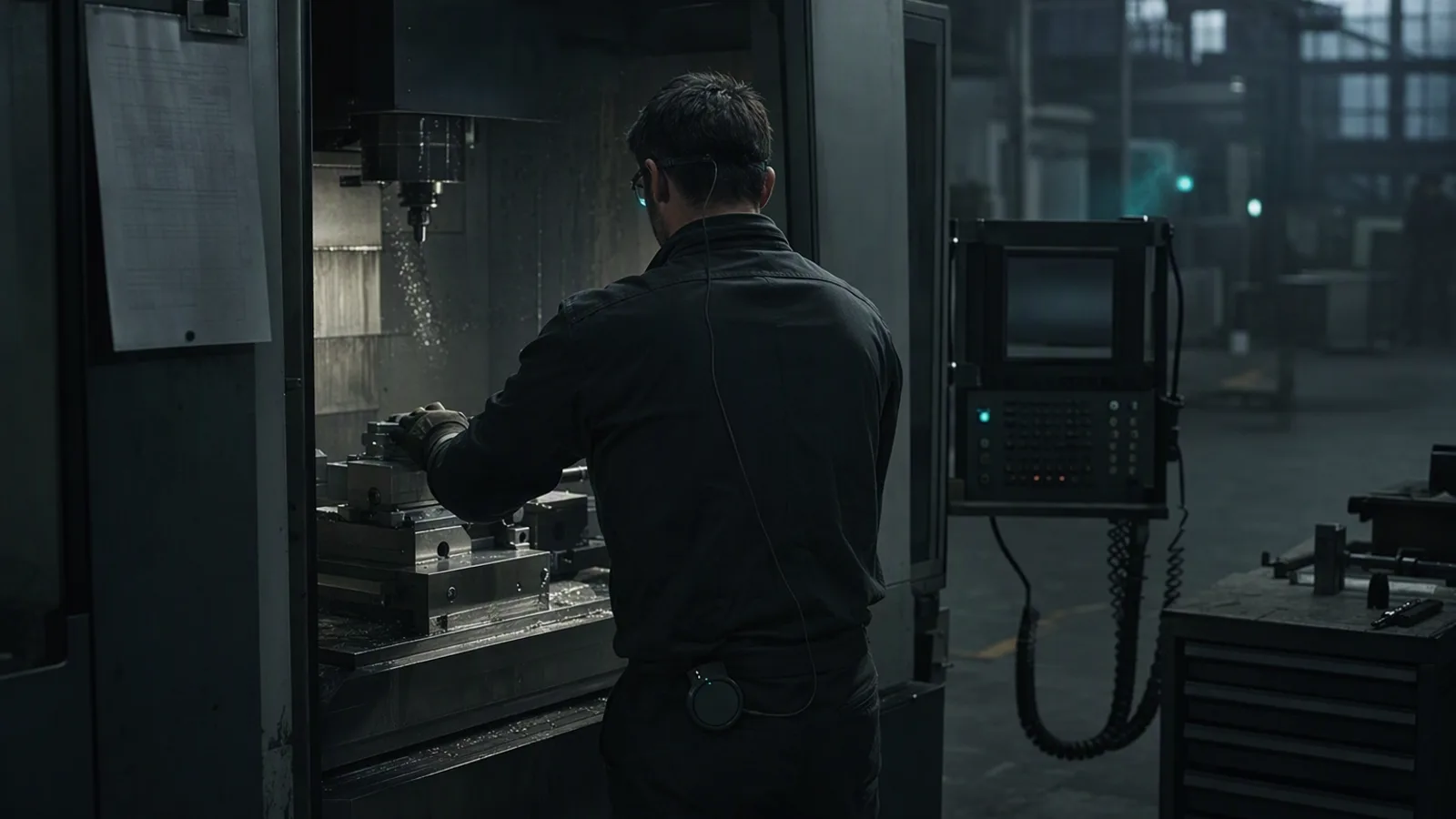
An operator at a machining cell is changing over to a job she has run twice this year. The setup sheet is on a clip by the machine door. The current tolerances are on a terminal three metres away. The bar stock’s batch number goes into the traceability record after the first part is measured, by which time her gloves are oily. Nothing here is broken. The information simply lives in three places, and her hands are in the machine.
That is the job display glasses are now being sold for. On 7 October 2026 XREAL put a price on Aura: portable spatial computing glasses powered by Android XR, developed with Google, with Gemini as the built-in assistant. The glasses are optical see-through, weigh under 95 grams and show a 70-degree field of view on Sony micro-OLED panels. Two tracking cameras follow the head and hands; a separate high-resolution camera, with a privacy light, is there for what XREAL calls real-time AI perception. A cable runs to a compute puck with a Qualcomm Snapdragon Reality Elite chip, rated at 48 TOPS for AI, a 4,455 mAh battery, Wi-Fi 6E and a fingerprint reader. The puck doubles as a trackpad and offers full ADB access.
In other words, an AI agent gets eyes, ears and a computer in your pocket. The question for a plant is not whether that is impressive. It is what the agent would actually be looking at.
The real cause is not a missing screen
The operator above does not lack a display. She lacks the right information at the point where her hands are, and a record that is written as the work happens rather than reconstructed afterwards. Glasses move a screen closer to the eye. They do nothing about where the data comes from. An agent behind the lenses is exactly as good as the system it reads, and in most plants that system is a spreadsheet that actually runs the plant and a terminal nobody trusts.
Where glasses help at a workstation, and where they get in the way
Work instructions at the point of use. The current revision of a setup sheet, a torque sequence or a photo of the correct fixture, shown while both hands stay on the job. Useful only if the revision in the glasses is the controlled one, not a PDF somebody saved last spring.
Machine data in the line of sight. State, cycle count, the last alarm, read from where the signal already exists. Useful when it saves a walk to the terminal; distracting when it competes with a spindle, so the content has to be sparse and easy to switch off.
A traceability record without a detour. The camera could, in principle, help capture which batch went into which part at the moment it happens. Whether it reads your labels reliably in the light of your goods-in bay is something to test, not to assume, and the entry must still be confirmed by the person who did the work. That is the difference between traceability for an audit and traceability for a recall.
A cable on a factory floor. Aura is wired: the glasses connect to the puck by cable. Near rotating spindles, conveyors and moving fixtures, anything that hangs is a snag point. Where glasses are allowed is a decision for your own risk assessment under the machinery safety and workplace rules that already apply to the station, not for a product page.
Eyewear that is not protective eyewear. Aura is sold as spatial computing glasses. Where the floor requires safety glasses, someone has to decide whether display glasses fit with them at all.
A camera that sees colleagues. The privacy light tells people a camera is active. It does not ask the person at the next station whether they agree to be in the picture, and it does not decide how long the footage is kept.
Price and availability. Aura starts at USD 1,279 (12 GB/256 GB) and costs USD 1,499 with 16 GB/512 GB. Shipping starts in the United States, Canada, Japan and South Korea; further markets follow in 2027. Poland and the rest of the European Union are not on the first-wave list. For a European plant this is, for now, an import for a pilot, not a purchase for a line.
What to do instead of ordering a box of glasses
Start from the record, not the device. For one station, decide which instruction, which three numbers and which traceability entry the operator needs. If those do not exist digitally today, the glasses will show nothing worth wearing them for.
Keep the glasses read-only towards the machine. MESCATOR reads the floor and is never in the control path. If glasses ever show MESCATOR data, they show the same read: no gesture, voice command or button in the lenses starts, stops or changes a machine. Confirming a traceability entry writes to the record, never to the equipment.
Ask where the AI runs. XREAL does not publicly break down which parts of the AI work happen on the puck and which in the cloud. Before a camera on your floor is switched on, get that answer in writing, together with what is sent, where, and for how long.
Write the camera rules first. Which zones, which tasks, when the camera may be on, where images go and who may see them. Agree it with the people who will wear the glasses and the people who will be in their field of view.
How we think about this at MESCATOR, as a direction rather than a feature: glasses are one more screen for the same works order, served from your own infrastructure. The platform side of that question, what runs on the device, what in the vendor’s cloud and what in the plant’s systems, is in Android XR on the floor: read access, never control.
A test you can run this shift
Pick one workstation. For one shift, every time the operator walks away from the machine to read or record something, note where they went, what for and how long it took.
If most trips are to read information that is not digital, fix that first; no glasses help. If they are to a terminal that already has the data, put a tablet on an arm next to the machine for a week. That tests the idea for the price of a bracket. More on the approach on the MESCATOR homepage.
Sources: XREAL Aura, XREAL press release, 7 October 2026, 9to5Google.
- XR glasses
- AI agents
- work instructions
- traceability